

Paradoxa: Update 4
It's Here! Assembly and Binding
Dear friends, I’m excited to announce that Paradoxa has finally approached completion. With a few personal delays, as well as those caused by waiting on certain materials, I just want to thank folks—particularly contributors—for their patience and grace while this project took form.
As always, it has been a joy to watch as contributors receive their copies. Without them, none of this work would be possible, as one can’t make books without content to fill them. So I thank them sincerely for blessing the press with their work and giving me the opportunity to do what I love!
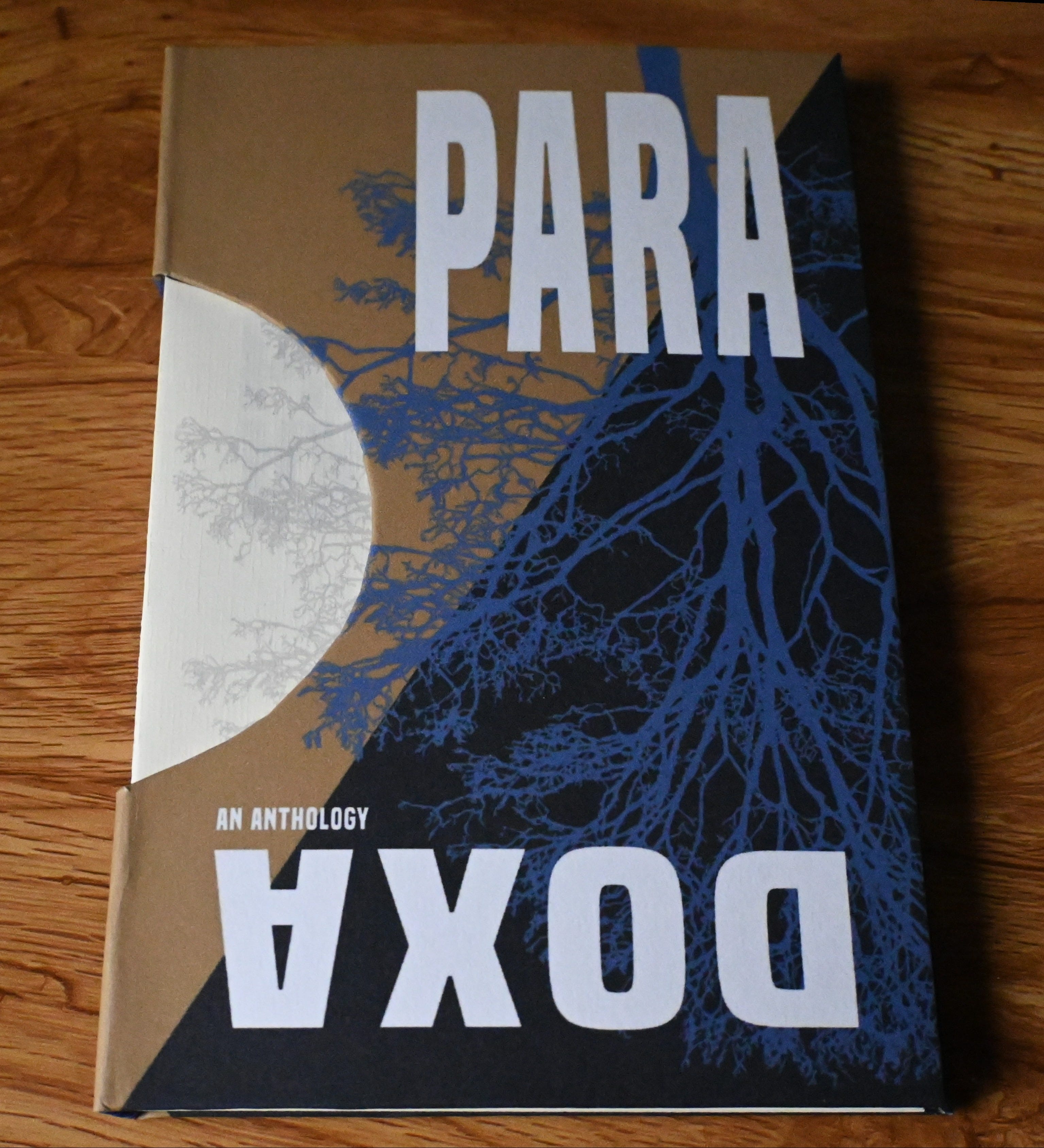


Here is Paradoxa. My hope in curating this book was that readers might wrestle with it—physically, mentally, and perhaps even a little spiritually. Well, I can attest that I too wrestled in all these ways while I was making this book! I had a very specific vision for how I wanted it to turn out, and I, stubbornly, could not deviate from that vision even when the design proved harder and longer to manifest than originally thought. “Where there’s a will, there’s a way,” is a saying that, for better or worse, dictates many of my life’s choices. Nevertheless, I’m pleased with the final result, and I can’t wait for readers to finally enjoy it.
Behind the Bind: Assembly
This year, I wanted to experiment with a few different materials in order to introduce diversity between print editions. With I Will Set a Place for You, I had designed it with a cloth cover and a dust jacket. For Paradoxa, I wanted to give soft touch laminate a try, mostly because I thought it might be a little easier and less time consuming to work with than fabric, which involves a lot of prep work. But I think I actually found the laminate more difficult to work with. Though coined “soft,” I found it rather stiff, and with its low surface energy, it was resistant to being glued down. I had to sand both the laminate and the board with a fine grit in order for it to bind together, much like scoring clay (my poor wrists though). There may have been some cussing and slumping over my work desk in temporary defeat over this part of the assembly process. I think I will be experimenting with different paper weights in the future, but because the material had been purchased and the covers already printed, I persevered for the desired result. Despite the struggle, which has probably more to do with technique and practice than anything, I loved the effect. This opens up a lot of different design avenues, so it will remain a staple in the studio.


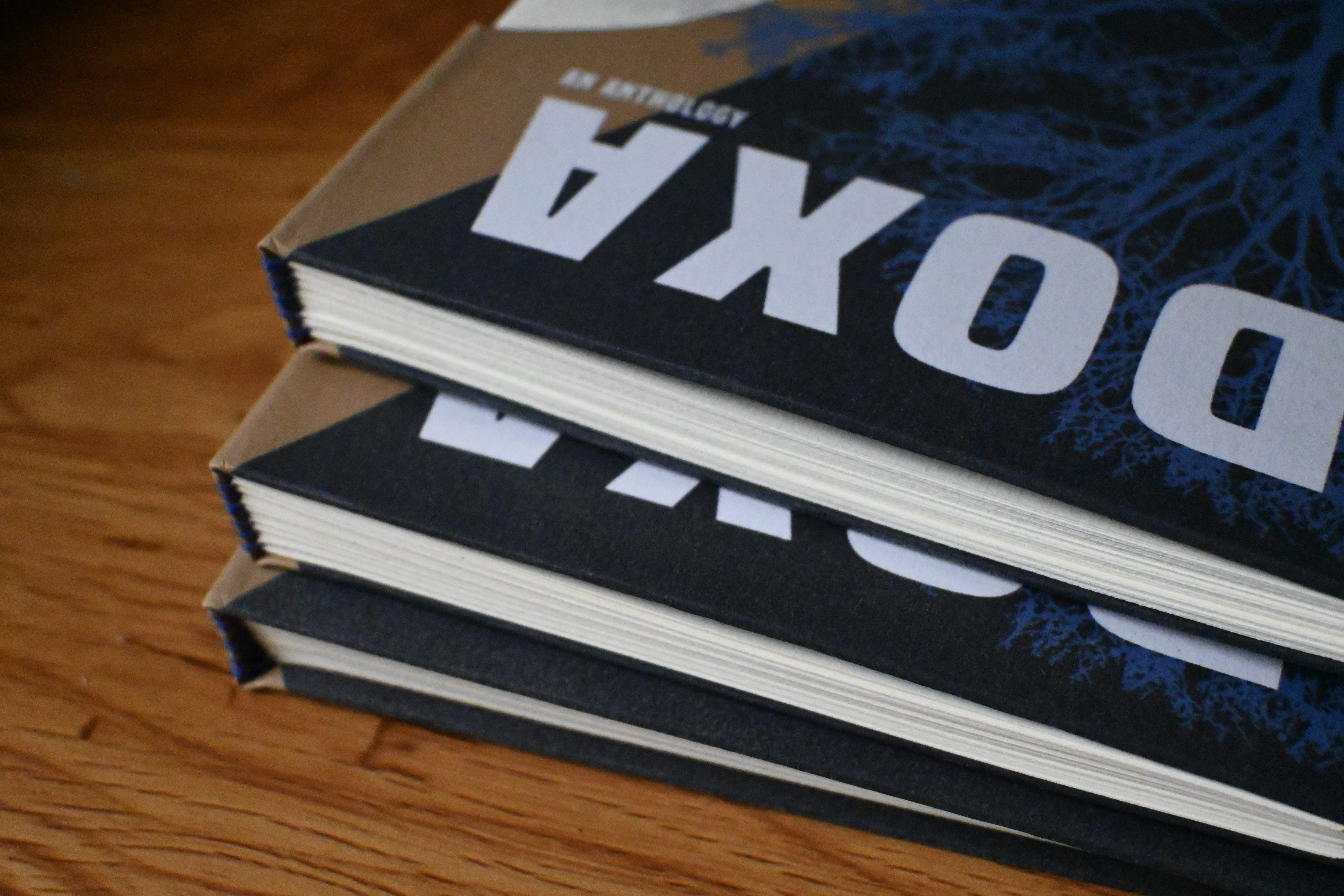
I also worked with a new binding technique called “buttonhole binding,” in which a section of the spine is cut out. What drew me to this binding is that it has somewhat of an inside-out appearance, as typically the sewing of the text block lies behind the spine and remains unseen. I felt that this fit with Paradoxa’s overall theme and design as a window into a different perspective, with a bit of a raw touch. With the exposure of the half-title through this window, I hope that it provokes a sense of invitation and curiosity. I also simply love exposed-spine bindings, because it’s not something one can find just anywhere, so it’s a feature I like to include when handbinding.
Once again, however, this was a new technique, and while the sewing was fairly straightforward, it was the case assembly that I struggled with. Math and I are not friends, and this design required a certain level of precision; several measurements needed to align for things to come together (cue more hair-pulling). But once again, the end result was exactly what I had envisioned. I love the way this binding allows the signatures to lay flat within the case.
Humanity in Art and Perfection
I also wanted to touch on a different kind of struggle I experienced while making this book, mostly because I think (or at least hope!) that you creative folks can relate. Another aspect of wrestling I underwent during this project was with my humanity and its limitations—and I simply mean the limitations gleaned from my own perceptions of myself and my circumstances. I know that we all have them, and that these limits look different for everyone.
Despite my love for this work, and my passion for signs of the human hand in art—especially now in light of the lines AI has begun to cross—I realized I ironically hold myself to a sort of machine-like standard, both in my workflow and in the end result. I was frustrated by the interruptions of living life as an embodied person and all that that entails: taking care of the body, working to pay bills, maintaining social connectedness. I’ve been so blessed with the busyness of loving and being loved, and a part of me resented that because I wanted to be able to work like a machine. I often joke that I wish I didn’t have to sleep or eat. So if I took the phone call over spending an hour at the desk, or assembly didn’t quite align perfectly to the millimetre, or I came home from my day job too tired to lift a finger, I struggled with a lot of shame in that. Shame firstly to God, as I do feel called to this work, but I often place it on the backburner when it competes with other responsibilities like my day job; shame in letting contributors down because of delays (and this shame was entirely self-imposed, as Paradoxa’s wonderful contributors were so patient and kind with each one. Bless you all) or imperfections in the work; shame in struggling to be fully present in my day-to-day life because the work that needs to be done here tugs on my heart and mind, always.
I’m sure I’m not alone in this. I’m sure most of us on here are wrestling to balance embodiment, daily responsibilities, love, and our calls. But this project left me considering the fact that, as human beings, isn’t honoring our design, with all its needs and limitations, a sign of worship? Isn’t my humanity supposed to move me to lean on my Saviour as my stronghold and justifier, rather than slip into shame? And since the grace of God in and for my humanity is supposed to help us all recognize it in the people around us, why can’t I seem to anticipate that others will extend the same grace towards me? Especially when nine times out of ten, they do.
I’m still reckoning with the answers to those questions, and why I have them in the first place. I guess some lessons need to be learned a few times over. But I did start with actively rejecting the notion of machine-like productivity. Which means allowing things to take time, embracing those blessed interruptions, and ultimately letting the work be imperfect. And that’s the way it’s supposed to be, because otherwise, I would not be honoring my humanity or my place in creation.
So I hope that with these print editions, both the work within and its physical features can be viewed as a sort of signature, a sign of my humanity and the humanity of its contributors reaching out to yours. I am not a machine, and therefore each copy of this book is one of a kind in its own flaws and triumphs. You may notice an additional knot where I needed to tie off extra cord because I didn’t quite measure enough. There might be an ink smear where my printer went rogue, or a shiny smudge of glue I didn’t notice on my fingertips. These books have seen all the different sides of me, from working in that blissful flow where everything divinely aligns, to wiping away frustrated tears in front of a mess because things were just not working. In the same way, each contribution within holds not only the story it tells, but a history in its creation, a piece of the writer (contributors, feel free to share that part of you in the comments!). Paradoxa is therefore a collective creation borne out of living within the tension of our humanity as fallen creatures made in the image of a perfect God, who knows each of our hearts better than we know them ourselves. All I can think is: how lucky are we.
Thank you again to Paradoxa’s contributors: Dabney Baldridge, Timothy E. G. Bartel, Kellie Brown, Hannah Christmas, William Collen, Zoe Hickerson, Abigail, A. A. Kostas, Henry Lewis, Julia McMullen, Zane Paxton, Trent Pcenicni, Abigail Perez, Kimberly Phinney, christina rikkers, E R Skulmoski, James Tynen, Kassi Wilson, Dorothy Nielsen, Todd Truffin, Michael Shoemaker, Silence Magdalene Grey, Eric Colburn, jonathan kelley , Jim Tynen, Rachel Boetig, Fair-Minded Poetry, Sherry Poff, Chelsea Barnwell, Michael Jones
*contributors, if you name isn’t linked and you have a Substack account, please message me so I can link it here!
And finally, if you’re interested in purchasing a copy, Paradoxa is available in both physical and digital copies here. The physical copies have been posted as a pre-order, as I make them as the orders come in. Thank you all for your support!
 | A guest post by
|
Brooke! I’m full of joy! I am so excited about this project and stunning anthology. Feeling blessed to be one of many contributors/writers. 💯💝
Reading as we speak :) wonderful so far :)